With a jug of hot coffee, paper cups, and a book in hand, my wife is off to her weekly women’s book group. That’s right, weekly. The group meets seven consecutive weeks in the fall, in the winter, and in the spring, taking a long summer break to allow the members to hike the Cascade Mountains. Each year a few of those hiking women are now leaving the group. Founders of the book group thirty-five years ago, they lived into their eighties, experienced the vicissitudes of three American decades, survived the deaths of their husbands, and read a great many books. My wife is keeper of a spreadsheet that lists books the group has read since the mid-1970s. The sheet has 850 lines.
The reading group being a social animal, a jug of coffee is its good friend. Too much is made of reading as the purpose of a book group (remember to “conscientiously separate the socializing from the discussion, ” warns a book on leading groups.) Often one or more members of my groups have not completed the scheduled reading. My readers have busy lives. According to some book club gurus, members who don’t keep up with scheduled readings should be asked to leave. Silence is also to be eliminated. I once had a group member ( I can't say "participant") who sat through six sessions on Swann’s Way and another six on Moby-Dick without saying a word. A woman who has followed me though several groups over four years rarely speaks. The veteran book group leader would have me think I failed for not “having drawn out” the silent attendee. I say, let all who want to attend come. The jug of coffee is the book group’s friend.
It is true that a group moderator must occasionally redirect a discussion that seems to be irritating the group (making sure the discussion is not irritating only the moderator). Several years ago the founder of a book group wrote to Slate’s etiquette expert, Prudence, complaining of a bully who “sighs loudly and makes faces at the suggestions other members make. Then, when we select the book, she will say things like "Well, that's not the book I would have chosen." The bully like to “ ‘play devil's advocate’ and argue for argument's sake.” Prudence recommended having coffee with the bully to inform her of the group’s “unwritten rules of civility.” Luckily, I have not needed to arrange a meeting over coffee. But the extended digression and the interesting side-topic are inevitable, even in the most cohesive groups.
I do not mean to play down the importance of reading. Sophisticated readers who have a developed a deep sense of the English literary tradition compose my book groups. Like them, I have spent much of life reading. Unlike many, I also spent years of professional training to learn and critically evaluate literature, and have directed a good chunk of energy to using the information and experience of acquiring it to teach others how to do the same. We all are avid readers.
My friend The English Teacher is devoting himself to teaching reading to high school students, enormously difficult as he is working with teenagers to whom English is their second language. Your time couldn’t be better spent than reading his wide-ranging, thoughtful essays, whether they explore the problem of teaching reading to the gap or comment on Hamlet or remark on the value of “incompetent reading.” He helps students learn to read at a rudimentary level, knowing that skill may lead to more satisfying forms of reading. I hope to help others further enrich their already sophisticated reading. Perhaps my comparison is an erroneous. Still, to lead a group through a discussion of a book is not to teach, whatever permutations one wishes to assign to teaching. In an essay on “The Decline of the English Department”, William C. Chace writes of a time when
We began to see, as we had not before, how … books could shape and refine our thinking. We began to understand why generations of people coming before us had kept them in libraries and bookstores and in classes such as ours. There was, we got to know, a tradition, a historical culture, that had been assembled around these books. Shakespeare had indeed made a difference—to people before us, now to us, and forever to the language of English-speaking people.
Part, a large part, of getting to know a literary tradition and a historical tradition requires a rigorous approach to reading that book groups don’t admit. The goal of the fellowship I received in graduate school was to send me into the world to teach, to help others understand the traditions that inform our literature. On second thought, I hardly believe I am doing so. No, I go off with the jug of coffee to my book groups so I can participate in genial literary discussions, happily.
The day was cloudless. Standing on a rise, my nephew’s wife was remembering her husband when I heard her ask us to join her. My brother, his living children, and I walked slowly up the hill, behind the gathered mourners. She offered a chance to speak. My living nephew said a few halting words, then his sister. I tried to form words, but could only see a reclining figure frozen upon a crypt’s lid.
Summers ago, my family visiting from a distant state, we had followed him across the property to the stream, beating our way through tall grasses and thick alder along the stream bank. A photograph from that time shows him smiling, his older daughter on his back, his younger in the arms of his wife. Soon he would not walk. His wife guided the mourners down the hill to a stream. On this chilly cloudless day fall frost had cut down the meadow grasses. I watched her pour him into the shallow water. After the others had returned to the house, I looked at his bone dust lying on the streambed. Even in death he wouldn’t move.
******
The meeting ended early. A call to United yielded one remaining seat on the commuter flight home. He would have to hurry. There was time, but none to waste, so he was relieved that traffic moved along. He deposited the rental car (express checkout, he still had time), then walked briskly to the boarding area. A United gatekeeper greeted him by name with a boarding pass. Not until he was onboard did he see his seat was a window in the last row.
He made his way down the aisle, stuffed his bag into the overhead. Releasing a seat belt extender, an obese man lumbered to a stand to let him in.
He looked out onto the tarmac, glistening from a late afternoon squall. Eyes closed, he imagined the first open space that came to mind. Andros. He was on the open water, bone fishing. He could see sunlight bounce along the far-reaching rippled sea surface. I can do this, he told himself. Sweat broke out.
“Ladies and gentlemen, we’re ready to pull away from the gate. We’ve closed the cabin door and ask that you turn off all electronic devices.”
He had ignored the words countless times. Now they propelled him out of the seat.
“Sir, you must sit down. Sir, sit down”
“Open the door. Please. I have to get off.” It was impossible to return to that seat.
“Take mine,” suggested a passenger in first class. Reaching for bills, he saw the passenger wave away the offer and sat, beyond shame, not caring a damn about the gawkers.
******
Berenicë is full of vitality when the Edgar Allan Poe story of that name opens. The narrator, on the other hand, is suffering from a sickness. “I, ill of health, and buried in gloom—she agile, graceful, and overflowing with energy.” As the story unfolds, she becomes progressively more ill, dying toward the end, he more obsessed and gloomy. Bernice’s fall into illness sets the plot in motion; the narrator’s derangement fuels it.
In “Berenicë”, as in many Poe stories, ideas seem to bring into being the worlds his narrators inhabit. To say that a Poe character misperceives the world because of a psychological (or psychoanalytical) disorder is to diminish Poe’s achievement. “Berenicë” holds an epistemological problem; the world becomes whatever a character might imagine.
Poe inverts Locke’s argument that sensation creates ideas. Bernicë’s teeth are “des idées” which the narrator coveted “so madly!” Because ideas generate the real, we know as soon as he begins to obsess that something gruesome will result (another inversion, turning Romantic contemplation into gothic horror).
At the end of the story, there is a leap from the mind of the narrator to the effect his mind has had on the world. A knock of the door. A servant enters, bringing with him the world the narrator has transformed. Bernice’s grave has been violated. The servant adds another horrifying detail: Berenicë was found alive in the open grave. The narrator notices his own clothes, blood-stained and muddy. A box falls to the floor, spilling Berenicë’s teeth. The reader need not try to work out the logic.
Poe wrote two other masterpieces that contain premature burials, “The Fall of the House of Usher” and “The Cask of Amontillado.” None are from the point of view of the buried. Only the mind affecting the burial mattered to Poe.
********
“I leave bedtime until the last possible moment compatible with my nurse's need for sleep,” writes the historian Tony Judt, who suffers from Lou Gehrig's disease.
I am sat upright at an angle of some 110° and wedged into place with folded towels and pillows, my left leg in particular turned out ballet-like to compensate for its propensity to collapse inward...
I am then covered, my hands placed outside the blanket to afford me the illusion of mobility but wrapped nonetheless since—like the rest of me—they now suffer from a permanent sensation of cold. I am offered a final scratch on any of a dozen itchy spots from hairline to toe; the Bi-Pap breathing device in my nose is adjusted to a necessarily uncomfortable level of tightness to ensure that it does not slip in the night; my glasses are removed…
No children’s prayers or pleasant stories here at Tony Judt’s bedtime hour, he tells us. “...and there I lie, trussed, myopic, and motionless like a modern-day mummy, alone in my corporeal prison, accompanied for the rest of the night only by my thoughts.”
******
However infrequently or often, we fear losing control – of our jobs, our health, our means of negotiating through the years ahead. The claustrophobe acutely feels his precariousness. In the last row of the airplane, the window seat is indifferent to the man bolting from it.
I once received a prestigious award to study for a doctoral degree. The foundation that funded the grant, which was offered to students in all fields (I concentrated in American Studies), used three major criteria to determine who merited an award: academic achievement, passion for the value of education, and commitment to teaching as a career.
In addition to a generous sum of money, the award was an invitation into a fellowship. The foundation gathered my group of fellows for a week-long conference to meet one another and fellows from previous years. When the family that founded the program decided to shut it down, the foundation invited all fellows present and past to a last conference.
Many fellows went on to illustrious academic careers. I did not. Unable to find a suitable academic position after a time of contract teaching, I changed careers. Though there were understandable and compelling reasons to leave teaching, I felt at the time that I had betrayed the fellowship.
Although I did not understand this until recently, an invitation four years ago to lead a reading class at Richard Hugo House provided another chance to fulfill the intent of the fellowship. The invitation came from the Hugo House program director, who had peg me as a candidate for leading a class on Proust’s novel Swann’s Way. It would be an experiment for us both. The writing center was offering a couple reading classes for the first time. Although I had taught, I had never led a reading group.
Eight readers signed up for the six-week class. Discussion was lively. I asked the readers to make a short presentation on anything relevant to our reading, if they would like. No pressure. Each week I presented material I thought would clarify the reading. At the end of the six-week session, the class asked me to go on with In the Shadow of Young Girls in Flower. The class changed—several people dropped out and several new readers joined—but after some shuffling the group went on to read all of In Search of Lost Time.
A group that reads Proust can have heady discussions. Who are the different Marcels? Which is narrating? Why does Marcel Proust name his protagonist “Marcel”? Is Proust a Platonist or a Nietzchean? I raised topics, but let the group make its way through discussions. Readers were avid, open to ideas, engaged with one another. Each class seemed to bring new insights. I learned to hold back, allow the group exchange ideas, argue, commiserate (“I could kill Marcel.” “Isn’t he a jerk!”).
Since that multi-year session on Proust, I have gone on to lead groups in Moby-Dick, Henry James (an ongoing project), and Uncle Tom’s Cabin. By leading, I have been teaching in a way very different from my experience in the college classroom, reminding me of Elizabeth Hardwick’s observation that reading “consoles, it excites, it gives you knowledge of the world and experience of a wide kind. It is a moral illumination.” For both readers and leader.
“Why is it that here in the United States we have such difficulty even imagining a different sort of society from the one whose dysfunctions and inequalities trouble us so? We appear to have lost the capacity to question the present, much less offer alternatives to it. Why is it so beyond us to conceive of a different set of arrangements to our common advantage?”
In the current New York Review of Books, Tony Judt explores the history of our apparent inability to discuss social problems in moral terms. More here.
Forecast, a novel by Shya Scanlon, is being serialized over 42 different literary websites in the span of 21 weeks. Forecast found a home at Flatmancrooked and will be released in hardcover in Spring, 2010.
Of course, what could I do but watch. Blain led Helen and Rocket down a steep switchback ramp into the main area of the edu-musement park and I sat in my little wired-up viewing room, all wound-up, and watched. I watched, and waited. The Professor, when giving his first lecture to incoming Surveillants, likes to use a quote from Franz Kafka both to prepare people for what they face, and to remind them of the fact that they might not always fully understand it, or fathom its full scope:
“All human errors are impatience, a premature breaking off of methodical procedure, an apparent fencing-in of what is apparently at issue.”
Obviously, this quote is relevant not because we are often waiting for some particular thing, as Surveillants, but simply a good principle to guide our temperament when performing the job. One is rarely tasked with looking for specific behavior, attitude or information in or from a watchjob; the Surveillant must stand back, rather, and create his or her narrative without prejudice, absorbing all data and filtering via the intuitive connection one establishes with one’s subject. Perhaps this is why I found it so excruciating as I watched, just then, and waited for the Professor to return. Each laborious, careful step they took down into the pit was painful. Each small pause for Rocket to sniff something out, or for Helen’s seemingly innumerable examinations of the wall on which the ramp was built, or of the ramp itself, or of the view. The whole thing was maddening, and it wasn’t until they’d fully descended to the park floor that the Professor finally appeared behind me, and tapped my shoulder.
I turned around and opened my mouth to exclaim only to find a hand over my mouth, and the Professor’s index finger raised to his lips.
“Shh,” he said. “Follow me.”
I turned back the monitors. “But Professor, Helen is…”
“Zara can wait for a minute, this is more important.”
The Professor gave me a look that made it quite clear I was not to refuse. I double-checked the recording devices, locked the keyboards, and stood up.
“I’m sorry,” I said. “But you know I don’t like to leave her alone.”
“Come with me. Quickly.”
The Professor led me out of the room and down the hallway. We passed by door after door leading to other viewing rooms, and I wondered if there were any other watchjobs out there with warrants, and how their Surveillant was responding. Was the Professor helping anyone else out? Was anyone else being separated from their subject? We took two more turns, went down a staircase, and I’d just begun to wonder whether he was taking me to a high security area when he suddenly stopped, put his face to a wall where his retina was scanned, and then disappeared right through it.
Of course I’d seen this kind of technology before, but I didn’t know we employed it in the office, and I certainly hadn’t used it myself. I stood in front of the wall, and, looking closely, could see that what was before me was not solid. Nonetheless, plunging headlong into it gave me pause. I stuck a finger through, then a hand. I edged the tip of my foot through, not wanting to trip. Suddenly my hand was grabbed, and I was pulled through the wall into a large room with long steel tables and various instruments lying about, mechanical and otherwise. There weren’t any windows, but the light was soft, ambient, not the harsh industrial lighting of the areas outside this strange sanctum.
“Sorry, Max,” the Professor said. “You weren’t moving quick enough.”
I looked back at the wall I’d come through. It was a clearly marked door.
“Is this your… office?”
“My lab, yes. Now come with me. There’s something I want you to see.”
We walked past a number of tables, all strewn with papers, gadgets, and as we walked the Professor began to explain.
“The bad news is I couldn’t find the source of Zara’s warrant, which means it’s either very high, or Homeland Security.”
We passed a table with several caged mice on it, most of which were alive.
“Not to toot my own horn, here, but I think you know I’ve got friends in high places. Damn near the top, actually, in most departments but Homeland Security. Never had any interest, frankly, and they’ve never invited me to any parties, if you catch my meaning. Comes down to a different set of values, I guess. Point is, we’re on our own on the warrant, for the time being.”
We stopped at a table that was covered with AS-Masks in various states of disassembly.
“The AS-Masks are a different story.”
The cool almond eyes stared in all directions despite being cut crosswise, lengthwise, or pulled apart in layers. The ducts that pulled moisture from the skin and excreted it onto the surface of the mask were under microscopes, as were patches of the mask skin itself, which, so lifelike, gave the scene an almost macabre aspect. The Professor, either not sensing my discomfort or simply ignoring it, picked up a flap of slightly hairy skin and waved it in my face. I took a step back.
“At first I was baffled,” he said, and put the piece back down. “Of course, I didn’t know what I was looking for.
“I took a few apart in every way I could think of before deciding to take a step back and assuming a fresh perspective.”
The Professor came closer and put his arm around me in a friendly, fatherly way. He gave my back a few light pats.
“And Max, it was something you said that really got me going in the right direction.”
“It was?” I felt my cheeks flush.
“It was indeed. I remembered that before I found out about how they’d been paid for, you’d described some strange behavior you’d noticed in Helen when she wears one.”
“Right, she gets all…”
“Well, I didn’t notice any strange behavior, per se, but your observation made me consider the objects from a different perspective. I put one on.”
“What happened?” I asked, trying to mask my impatience with enthusiasm. “What did you see?”
“What did I see? Well, I just saw the room, of course. But follow me over here for a second.”
We walked over to a conduction spot near a panel of monitors not unlike those in my view room. This conduction apparatus, however, had gauges I’d never seen before. The ETM glowed a bit, and as we stood in the spot it began to pulse, the gauges mounted beside it lighting up.
“These gauges measure the emotional input occurring during transfer. I’ve been keeping a record for my own research of my output, but that’s not what’s important. What’s important is, here.” He handed me an AS-Mask. “Put it on.”
“Right here?” I asked, but didn’t wait for an answer. I put on the mask, and turned toward the Professor. Sure enough, the room looked no different. “What am I supposed to see?”
“I’ll show you,” he said, and turned me toward the gauges again. They indicated a reasonably low level of input. I was pleased, at least, that this didn’t come at a time when I had something significant to hide. It would have been embarrassing. “But I don’t really know what my average is,” I protested.
“Of course you don’t. But that’s not the point. Now take the mask off while keeping an eye on the gauge.”
I did so, and right as I removed the mask the indicator leapt up ten or fifteen percent higher than it had been.
“It shot up,” I said. “What does that mean? Should it have gone down?” I suddenly felt ashamed.
“No no, it did exactly what it was supposed to. You see, these masks are made to deflect a certain percentage of emotional energy from its natural path to the ETM, so there’s less stored. That’s why you see a jump in the amount registered by my gauges when you take the apparatus off.”
I was struggling to put this together, and I must say that my thoughts of Helen walking through that park all alone stymied my attempts at logic even further.
“But if the masks are made by the Energy Department,” I asked, “why wouldn’t they want that energy stored?”
“That’s just it, Max. It is being stored. Just not by the person wearing the mask. My theory is that the ambient emotional energy is being somehow absorbed into what are probably vast cells of ETMs.”
“Where?”
“Well, I don’t know yet.”
“Oh.”
“But that’s where you come in.”
“Me? Professor, really, I have to get back to Helen. Can’t we—”
“If you really want to help Helen, Max, we need to know where this energy is being stored, and who is responsible.”
“But can’t someone else—”
“No!” The Professor barked. “We can’t trust anyone with this.”
“But what can I do? I mean how am I supposed to find this?”
“I’ve created something for you, Max.” The Professor picked up a small device from a table behind us. It resembled an old-fashioned radio, complete with a telescoping antenna and an analogue dial. There were wires taped to the sides and a small, red, digital screen showing a single bar, hovering toward the end marked 0.
“I’ve reengineered a small, portable ETM to act as a kind of divining rod,” he said. He handed it to me. “When wearing the AS-Mask, you’ll be able to track the direction of the deflected emotional transfer. You’ll be able to adjust the signal reception with that knob.”
I looked at the device in my hand, then back at the Professor.
“It should lead you to where this energy is being stored. I want you to take a look around, and report back to me.”
I was stunned. This is not the type of thing I was supposed to be doing. This was not the type of thing I was trained for. Furthermore, Helen needed me. Rocket was a little wimp, and who the hell knew about Blain – he was a criminal, after all. He could be delivering her directly into the hands of whoever posted the warrant!
“Professor, please,” I said. I no longer cared how I sounded. “I’m just not up to this. I have no experience—”
“Spying? You have no experience spying? My dear boy,” he said, “you’re one of the best we’ve got. The only difference here is that you’ll be there in person, seeing it with your own eyes!”
“Yes, but…”
“No buts! This must be done! I would do it myself, Maxwell, but I’m an old man. I can’t move very well at all, let alone quickly, and besides, I can cover for you much more easily than you can for me. Believe me, I’ve thought this out quite thoroughly, and it’s the only way.”
My mind raced for another good excuse, but it occurred to me that I didn’t truly know why I didn’t want to do this, or rather, that the true reason might in fact be as simple as fear. Fear isn’t the most invalid reason, of course, but it also wasn’t the reason I was giving, and wasn’t, moreover, going to further expand the Professor’s understanding of the situation at hand, or help him help me help her. I was at a loss.
“The only way,” I repeated, just to see how it sounded coming from my own mouth.
As resignation closed in, uncomfortably tight, around the role I was to play in what had to be done, I played with the machine I’d been given, turning it over in my hands, and it gave me an idea.
“Let me bring a portable viewing device, too,” I said, “so I can keep track of Helen’s movement, and contribute any insight that might be needed to interpret the situation.”
I knew this would be valuable, but what I didn’t know is whether or not carrying two devices might be cumbersome, or whether splitting my attention between the two would reduce the effectiveness of either task.
We were walking back to the table with the masks and the Professor paused, looked up at the ceiling, and thought. Likely, his calculation was of the above two issues, and in addition how far he could push me before I snapped, or made some other error in judgment. He needed me invested, and knew that if I was going to completely abandon my post, I’d need some assurance that I wasn’t entirely alone.
Though of course we’ll never know what he was really thinking.
At any rate, he agreed.
“I want you to use extreme caution,” he said, while we picked out the right size mask for me. “Both of the devices you’ll be carrying can under no circumstances leave your possession.”
“I understand.”
“If you think you’ll be unable to keep hold of them for any reason, they should be destroyed.”
We found a mask that fit, and I walked over to a small mirror above an industrial sized sink. I’d never worn one before, nor had I worn any kind of mask, really, since childhood.
“Had you ever worn one of these before today?” I asked.
“Heavens no,” the Professor said. “But I can’t say I blame the public for wanting protection from people like us.”
“People like us?”
“The people watching.”
“It feels…” I looked for the right word. “Powerful.”
“Then it’s doing its job.”
I thought of watching Helen in hers, and found the thought that we’d both be out there, in the world, looking so similar, strangely erotic.
The Professor shuffled off to a far wall and returned with the tiny monitor I’d use to keep tabs on Helen’s progress.
“Have you used one of these?” he asked.
“Yeah, just in the lab, but I should be okay.”
“I’ll be in your viewing room, and you can use it to speak to me if you need to. But keep the conversation to a minimum, if you can. I haven’t been at the helm for years, and it’s going to take all of my concentration.”
We walked together to the door of his workshop, and the Professor paused, letting me walk ahead. I turned around.
“What now?” I asked. “Where do I start?”
“Why, right here, of course,” he said.
I looked down at the mangled ETM, it’s red gauge still toward the bottom. “And so I just…”
“Point it and watch the gauge. Then go where it’s strongest.”
I chuckled. “Simple as that, huh?”
The Professor frowned. “Yes, simple as that.”
“Okay, well, I guess this is—”
“Maxwell you’re stalling.”
He was right. Somehow the whole thing just didn’t seem real. Never in a million years did I think I’d ever hear the Professor tell me to leave my post. But then, I never expected Zara to become Helen, and I never expected Helen to leave her house in the suburbs. The more I thought about it, the more I realized that this job had been just one unexpected thing after another. In fact, the only consistent thing at all, to that point, had been surprises. The last thing I realized was that I wouldn’t have had it any other way.
I took a deep breath, said a prayer for Helen, and stepped back through the door.
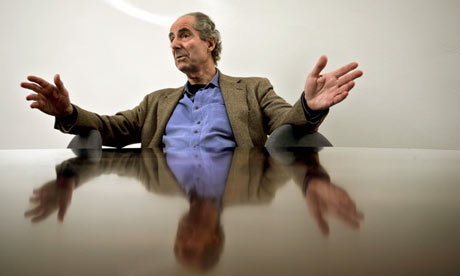
Philip Roth. Photograph: Orjan F Ellingvag / Dagbladet / Corbis
[Roth's is a pessimistic view of the novel's future.]
Philip Roth's late run of productivity has long been a source of wonder in the literary world, with his latest novel coming out this week less than a year after the last, and another already complete. But the 76-year-old's own energy is not, according to him at any rate, any reflection of vibrant life in fiction itself. Roth has long been pessimistic about the survival of the novel in a gaudy, short-attention-span culture, but his latest prophesy is one of his bleakest yet, predicting that the form will dwindle to a "cultic" minority enthusiasm within 25 years.
“…you can set in your window anywhere in Harlem and see plenty… But back windows ain’t much good for looking backwards nohow. I always did believe in look out front—looking ahead…”
The Sweet Flypaper of Life
Langston Hughes and Roy DeCarava
The Harlem photographer Roy DeCarava may be best known for one of the photographs that appeared in his 1955 collaboration with Langston Hughes. Graduation captures a black girl in a white dress walking along a Harlem street. It is a photograph of opposites: white and black, shadow and light, the image of the luxury car opposed to the dilapidated cart, the word Prince, truncated. Still, it is not an ironic image. Poised as she negotiates her contradictory world, the girl has—to use an 18th-century word now in disuse—equanimity. The viewer feels that she has determined her path, and is confidently moving along it.
DeCarava took Graduation the same year that Partisan Review published James Baldwin’s scathing essay on Uncle Tom’s Cabin (another coincidence: the essay and ten others appeared in Baldwin’s Notes of a Native Son in 1955, the year of DeCarava’s and Hughes’ collaboration). However dissimilar, DeCarava’s photograph and Baldwin’s essay address the state of blacks in America of the 1950s.
Baldwin’s attack on Harriet Beecher Stowe remains a power essay that is difficult to come to terms with. Uncle Tom’s Cabin, he writes, “is a very bad novel,
having, in its self-righteous, virtuous sentimentality, much in common with Little Women. Sentimentality, the ostentatious parading of excessive and spurious emotion, is the mark of dishonesty, the inability to feel; the wet eyes of the sentimentalist betray his aversion to experience, his fear of life, his arid heart,; and it is always, therefore, the signal of secret and violent inhumanity, the mask of cruelty.
Stowe was incapable of creating characters who are “resolutely indefinable, unpredictable,” whose fictional lives are a “web of ambiguity [and] paradox.” To create a “more vast reality which must take precedence over all other claims” is the goal of the novelist. Stowe failed to achieve it.
If we accept Baldwin’s argument, what’s left of Uncle Tom’s Cabin? Stowe used conventions of the 19th-century sentimental novel, the ideas of the “culture of domesticity,” and evangelical reform thinking to craft her novel. Baldwin’s aversion to the novel comes in part from their continued influence. Baldwin, perhaps most bothered by the novel’s “theological terror, the terror of damnation” that causes Uncle Tom to forbear whatever his masters’ do to him, sees the “tragedy” of Bigger Thomas, hero of Richard Wright’s Native Son, as his acceptance of “a theology that denies him life, that he admits to the possibility of his being sub-human and feels constrained…” Wright, in Baldwin’s view, had taken Stowe’s Uncle Tom, lock, stock, and barrel, and turned him into his complement, a raging, diminished black man. Looking backward at Stowe’s novel of 1851, Baldwin saw black novelists in 1950 unable to move forward.
In a reappraisal of Uncle Tom’s Cabin, Henry Louis Gates argues that Baldwin disliked sentimentality because, to Baldwin, it subverted sexuality, valuing false public displays of emotion over intimate and true feeling. Yet sentimentality was the only vehicle available to Stowe to express sexuality. As Gates demonstrates, a reader can find sexuality in nearly every chapter of Uncle Tom’s Cabin, “lurking within and near the story’s sentimental treatment of marriage and family life. “ No where is this more apparent than in the marriage of Eliza and George. From the beginning, Stowe presents Eliza as an attractive, sexual woman, as when the author compares her to Harry, her son.
There was the same rich, full, dark eye, with its long lashes, the same ripples of silk black hair, The brown of her complexion gave way on the cheek to a perceptible flush, which deepened as she saw the gaze of the strange man fixed up her in bold and undisguised admiration.
Eliza’s sexual nature is not lost to either the strange man, the slave trader Haley. Eliza’s sexuality is described again later, during her escape north, when she learns that she will be reunited with George at the Quaker house, her temporary refuge. She imagines hearing “her husband’s footsteps; she felt him coming nearer; his arms were around her, his tears falling on her face, and she awoke!” By dismissing sentimentality as dishonest emotion, Baldwin seems to have missed the underlying sexual nature of Stowe’s novel.
Sentimentality stands as a great hurdle for today’s reader of Uncle Tom’s Cabin, and one initially feels pulled to agree with Baldwin’s forceful argument. Stowe’s is a sentimental, polemical piece of fiction, more a pernicious political pamphlet than novel, isn’t it? That is how Baldwin saw the novel in the 1950s, and how we’ve been taught to think of it. “ To expose oneself in maturity to Uncle Tom may be a startling experience,” Edmund Wilson wrote in Patriotic Gore, his great work about the literature of the Civil War era. “Let us start with Uncle Tom’s Cabin” begins the book.